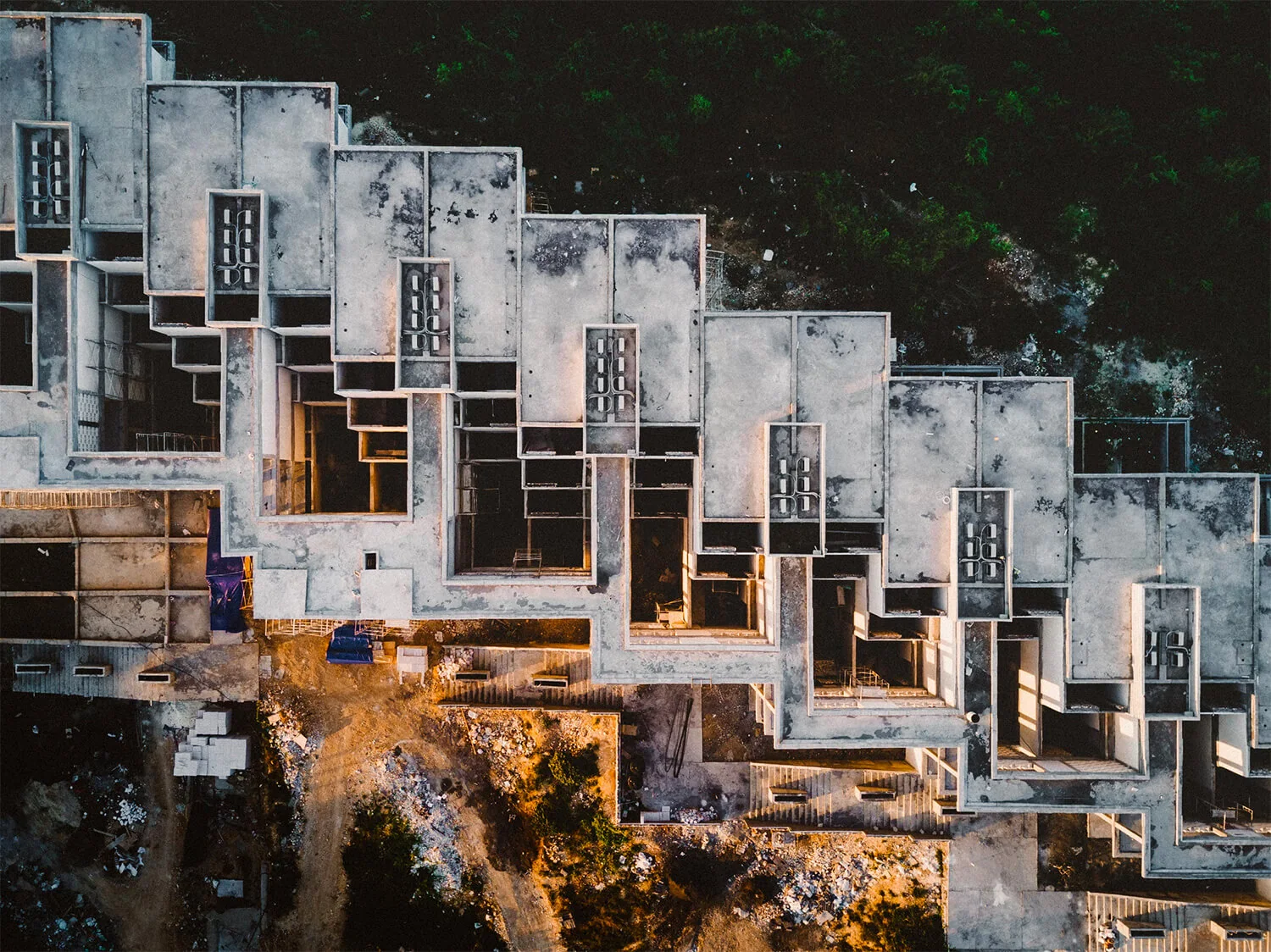
Construction progress photography becomes useful when it is repeatable enough to compare, organized enough to retrieve, and specific enough to answer a project question. A folder of attractive aerial photographs can support marketing, but it is not automatically a documentation program. Owners, general contractors, developers, lenders, design teams, and marketing departments often need different evidence from the same visit. Unless the specification names those needs, the provider is forced to improvise.
Dallas–Fort Worth projects add practical variables: large sites, long drive times, controlled airspace, active cranes, fast suburban development, intense heat, thunderstorms, high winds, complex logistics, and many stakeholders who may never visit the site. The goal is not to fly as often or as high as possible. It is to create a defensible visual record with consistent views, clear limitations, and a workflow that fits real construction operations.
This guide expands on the legacy article about using drone footage to document a commercial construction project by turning the idea into a procurement-ready specification. It covers objectives, baseline views, cadence, site responsibilities, data organization, quality assurance, marketing outputs, and scope boundaries. It does not convert photography into surveying, inspection, engineering, schedule certification, or proof of contractual performance.
Define the record before choosing a visit cadence
List the decisions the imagery must support
Start with users and decisions, not “monthly drone photos.” An owner representative may need a concise overview for a leadership meeting. The superintendent may need context around deliveries, laydown, earthwork, access, and major site transitions. A remote design stakeholder may need orientation around facade or roof progress. Marketing may need milestone footage that can later become a time-lapse-style story. Risk or facilities teams may need a dated visual reference without asking the photographer to render a condition opinion.
Write each purpose as a question the media should help answer. Examples include: What major areas visibly changed since the prior visit? How is the permanent site circulation taking shape? Which building elevations have progressed? What was visible before a later phase concealed it? Which milestone moments are available for an owner update or final project film? Questions produce a better shot plan than generic labels such as “site overview.”
The specification should also name excluded uses. Standard RGB photographs cannot prove dimensions, quantities, materials, concealed conditions, compliance, or causation. They do not replace the superintendent’s records, testing, licensed survey, design review, or professional inspection. If the project needs orthomosaics, measurement, thermal imagery, or another specialized product, scope and validate that capability separately.
Establish a baseline visit with fixed and flexible views
The first useful visit creates a visual coordinate system. Select a small set of fixed viewpoints that can be repeated through the project. Record the intended subject, camera direction, approximate altitude or framing, lens, orientation, and a plain-language identifier such as NW_CORNER_LOOKING_SE. Include enough surrounding context to relocate the composition after grading, walls, roofs, landscaping, and neighboring construction change the scene.
Fixed views support comparison, but a construction program should not be rigid. Temporary cranes, new structures, exclusion zones, sun position, active work, airspace provisions, and wind can make an earlier position unavailable. Define a tolerance: preserve the visual question and framing relationship when an exact camera position is unsafe or impossible. Record the reason for a material deviation in the visit notes.
Divide the shot register into three tiers
Use three priorities. Tier 1 contains the essential repeat views required on every successful visit. Tier 2 contains phase-specific views tied to current work. Tier 3 contains optional marketing or contextual images attempted only after documentation is complete. This protects the record when weather or site access shortens the operating window.
A compact program might have six to ten essential obliques and overhead contexts, several phase views, and a short set of video movements at milestones. More is not automatically better. Fifty loosely named photographs can be harder to compare than twelve disciplined frames. The team should be able to state what each recurring view is intended to reveal.
Choose cadence from the rate of visible change
Weekly, biweekly, monthly, and milestone visits serve different purposes. A fixed monthly date can support regular owner reporting but may miss a brief high-value stage. Weekly capture can document rapid earthwork or structural progress but can also generate repetitive media during slow interior phases. Milestone-only capture is efficient for a final story yet weaker as a continuous record.
Build cadence by phase. Mobilization, clearing, grading, underground utilities, foundations, vertical structure, enclosure, roof work, exterior finishes, paving, landscaping, and completion do not change at the same visual rate. A monthly base cadence with approved milestone callouts can be more informative than an inflexible weekly schedule. Define how much notice the project team will provide when a milestone moves.
Weather and operations can shift a visit without erasing its reporting value. Establish a window—such as a target week or a number of days around the reporting date—rather than one fragile hour. If the imagery is tied to a draw, meeting, or public announcement, identify the actual delivery deadline so capture and editing can be sequenced backward.
Convert every visit into a repeatable field workflow
Name the project-side site contact and authority
The remote pilot should not arrive at an active DFW jobsite with only a marketing contact’s phone number. Name the superintendent or authorized designee who understands current work, access, cranes, lifts, concrete operations, deliveries, visitors, and emergency procedures. Confirm where the crew parks, checks in, receives orientation, stages equipment, and may launch.
The site contact does not direct the aircraft or override the remote pilot’s safety decision. The role is to provide accurate site information, authorize ground access, coordinate with jobsite personnel, and identify conditions that changed since planning. If the contact is unavailable, the specification should say whether the visit pauses, proceeds only from an approved exterior property, or reschedules.
The FAA’s Part 107 rules remain applicable to the flight, including visual line of sight, yielding to other aircraft, and limitations involving people and moving vehicles. Airspace authorization is handled separately where controlled airspace applies. Project permission is necessary, but it is not a federal flight authorization.
Coordinate around cranes, people, and active logistics
Construction sites change hourly. Tower and mobile cranes, concrete pumps, lifts, haul trucks, material deliveries, blasting, roofing, testing, and emergency work can alter the operating plan. OSHA’s construction crane safety resources illustrate why crane activity is a formal site hazard rather than a background visual element. The pilot and superintendent should establish communication and separation without assuming that either party can casually stop critical work.
Schedule the aircraft where feasible around lower site traffic and predictable operations. A morning window may reduce heat and produce useful light, but it can coincide with deliveries and toolbox meetings. A lunch-period assumption may conflict with crane work, concrete placement, or public traffic. The right window is project-specific.
Use a stop-work and abort protocol for the flight
The brief should identify how the crew will pause or end the operation when a crane enters the planned area, nonparticipants move into the controlled ground zone, an emergency vehicle arrives, radio communication fails, weather deteriorates, or site conditions no longer match the plan. This is an aircraft stop protocol, not authority to stop the entire construction project. The remote pilot lands or moves to an approved alternative; the superintendent controls construction activity.
Record the visit, not just the images
Each delivery should include a concise visit note: project, date, local time, provider, general weather, requested versus completed views, material deviations, and any view not attempted. Do not turn the note into an unsupported opinion about progress, safety, quality, or cause. Its purpose is to explain the media set and preserve context.
Photography metadata can support traceability, but the project should not depend on a consumer gallery preserving every field. Retain original capture metadata according to the agreement and include stable human-readable identifiers in filenames or a manifest. If time is displayed on images, define the time zone and whether the label represents capture time or delivery date.
For the DFW region, use Central Time consistently and account for daylight-saving changes in systems that compare visits. A date alone may be sufficient for stakeholder decks; technical archives can keep full timestamps. Consistency matters more than adding every possible label to the visible image.
Specify image, video, and delivery standards
Define photography coverage by function
Recurring stills usually include site context, each building or work zone, access and circulation, perimeter conditions visible from approved viewpoints, major elevations, roof or upper-work context when available, and any owner-defined area of interest. Oblique views are often easier for nontechnical stakeholders to understand than straight-down images. Overhead views can clarify layout, but they may not reveal vertical progress.
State the number of final photographs, whether each is retouched, target dimensions, color space, file type, and whether both full-resolution and presentation copies are needed. Avoid specifying “all photos.” A selected set protects consistency and removes setup frames, redundant takes, and images captured only for field verification.
If the client supplies boundary, building, phase, or utility overlays, define who verifies the underlying information. The media provider can place approved labels without certifying that they are survey-accurate. Use “approximate” where appropriate and preserve an unannotated master alongside a labeled communication copy.
Use video for orientation and milestones
Video is most useful when movement communicates scale, sequence, or transformation. A consistent approach can show site evolution. A lateral pass can explain the length of a facade. A restrained orbit can connect multiple buildings. A milestone reveal can give the final project film a clear beginning or transition. Repeating every cinematic move on every visit may add cost without improving the record.
Specify source-select length, resolution, frame rate, color treatment, and whether a recurring edit is required. An owner update might need a short dated sequence. A final film may need archived high-quality selects rather than ten nearly identical monthly edits. Decide early whether ground footage, interviews, graphics, or schedule data will later be combined with the aerial archive.
Protect both horizontal and vertical future use
If marketing expects social derivatives, capture a few movements with protected central composition and sufficient headroom for vertical crops. Do not compromise every documentation view for an unknown platform. The specification can identify a small “campaign-safe” subset while keeping the core record optimized for clarity and comparison.
Build an archive that a new team member can understand
Use a durable folder and naming convention. One model is:
PROJECT / YYYY-MM-DD / STILLS_FINAL / VIDEO_SELECTS / MANIFEST
Files can combine project code, visit date, view ID, and sequence: DFW01_2026-09-15_V03_NE_ELEVATION_001.jpg. Avoid names that depend on one employee’s memory. Preserve a view-register document that explains every recurring code and records replacements when a view is retired.
Define the system of record. A provider delivery link is not necessarily the project archive. State who downloads, verifies, backs up, and places media into the owner’s or contractor’s platform. Define retention by the provider and retrieval terms after that period. Sensitive industrial or campus imagery may require named recipients, access logs, or deletion confirmation.
The DFW project portfolio can help stakeholders discuss visual finish, but a public portfolio is not the delivery model for a private construction record. Security, permissions, metadata, and retention should be specified independently.
Add quality assurance without inventing certainty
Review completeness before visual polish
The first quality check asks whether every essential view is present and identifiable. Confirm project, date, view IDs, file integrity, orientation, and the visit note. Then review technical quality: focus, motion, exposure, color, horizon, compression, and whether retouching changed documentary meaning. A visually beautiful set with one missing recurring view can be less useful than a modest set that preserves the comparison.
Create an exception process. If an essential view is unavailable because of a crane, airspace condition, people, weather, or site change, deliver the safest useful alternative and record the reason. Do not quietly substitute a different angle under the same identifier. The archive should distinguish “repeat view” from “replacement view.”
Keep visual observations separate from professional conclusions
Photographs show what the camera recorded under particular conditions. They can help qualified project participants identify areas for closer review, compare visible site states, and communicate remotely. They do not establish workmanship, code compliance, completion percentage, dimensions, quantities, structural adequacy, roof condition, or causation.
The DFW industrial inspection imagery page describes visual access use cases, but the contract should name the actual output and professional boundary. If a licensed surveyor, engineer, architect, inspector, roof consultant, or thermographer will interpret the media, define how that professional requests views and receives original files. Do not market the photographer’s delivery as that professional’s conclusion.
Preserve documentary integrity during editing
Routine global color and exposure correction can improve legibility. Removing a temporary object, altering a boundary, replacing a sky, or compositing different moments changes the evidentiary meaning. The specification should distinguish documentary images from marketing images. Keep unaltered originals or minimally processed documentation masters according to the agreed retention policy, and label any creative composite used for promotion.
Audit the program at phase changes
The shot register should evolve when the project does. A view of earthwork may become blocked by the finished structure. A roof view becomes important after enclosure. Landscaping and tenant improvements create new areas of interest. At major phase transitions, retire obsolete views deliberately, add new identifiers, and preserve the history in the register.
Do not change the entire system every month. A quarterly or milestone review with the owner, superintendent, and communication lead can decide what remains essential. The goal is continuity with a documented reason for change, not rigid repetition after a view stops answering a useful question.
Procure and launch the DFW documentation program
Issue the same specification to every bidder
The request should include exact address and parcel context, anticipated project duration, base cadence, milestone triggers, recurring view count, video needs, delivery standards, archive destination, access requirements, insurance language, current crane plan, reporting deadline, weather tolerance, and professional limitations. Ask bidders to identify assumptions, exclusions, travel, airspace planning, site waiting time, revisions, retention, and change-order rates.
Compare the same product. A low proposal that includes six photographs and no archive work is not equivalent to one with twelve recurring views, labeled files, video selects, visit notes, and a managed delivery. Conversely, do not buy an elaborate edit every month if stakeholders need a dependable visual record. Spend complexity where it answers a named project need.
Run a baseline acceptance review
Treat the first visit as commissioning. Within a defined review period, confirm that the view IDs, composition, image finish, metadata, filenames, folder structure, video selects, and visit note meet the specification. Resolve changes before the second visit. It is much easier to adjust one baseline set than to discover after six months that views cannot be compared.
Use the DFW construction drone services page to describe the project and desired record, then send the finalized scope through the DFW quote form. Include the site contact, anticipated start, duration, reporting cadence, essential areas, access protocol, and archive destination.
Commission the workflow before repeating it
The launch meeting should include the owner’s representative, superintendent, documentation lead, and provider. Review the current logistics plan, recurring view register, naming scheme, normal visit window, milestone triggers, weather process, and the person who can approve a necessary substitution. Confirm where the crew checks in, which safety orientation applies, what personal protective equipment is expected, and how active crane or lift work is communicated. The meeting is not a substitute for each day’s field assessment; it ensures that routine responsibilities are understood before the first visit.
Define how stakeholders request extra coverage. A project executive may ask for a new facade sequence, a consultant may request detail of a roof transition, or marketing may want a completed-building edit. Those can be valuable without silently changing the recurring baseline. Use a written request that identifies the requester, purpose, deadline, professional boundary, and whether the new view becomes part of future visits. This keeps one-time creative work from corrupting the comparison set.
Build a simple monthly acceptance checklist: visit date is correct; all essential view IDs are present; replacements are labeled; image and video files open; the manifest matches delivery; access or weather exceptions are recorded; and the archive copy is complete. The reviewer does not need to approve construction quality through this process. The checklist verifies that the commissioned media record is complete and understandable.
At project closeout, preserve the final register alongside the files. Mark retired views, milestone-only coverage, original delivery dates, and the approved archive location. If the owner wants a marketing edit, create it from approved clean media as a separate derivative with its own rights and review history. Do not overwrite the documentary masters with graphics, sky replacements, or aesthetic changes that could confuse future readers.
The finished archive should also include a plain-language limitations note. It can state that views were captured from lawful and safe operating positions, that temporary conditions could obscure parts of the site, and that the media is not a survey, inspection, certification, or measurement. When the archive changes hands, this note helps a new stakeholder understand both the record’s value and its boundaries without relying on institutional memory.
Assign a closeout owner before the construction team demobilizes. That person should verify the archive copy, final manifest, view-register history, permitted stakeholder access, provider retention date, and any embargo on public use. Sixty days after completion is too late to discover that the only complete link expired or that nobody preserved the baseline set.
Confirm the responsible person in writing at turnover.
Request a repeatable DFW construction record
A useful proposal should return a view-register approach, cadence, site responsibilities, deliverable quantities, file standard, weather process, retention term, assumptions, and exclusions. The standard of success is not that a drone flew on schedule. It is that authorized stakeholders can find, understand, and compare the record throughout the project without mistaking photography for a professional certification it was never designed to provide.